


Cart 0
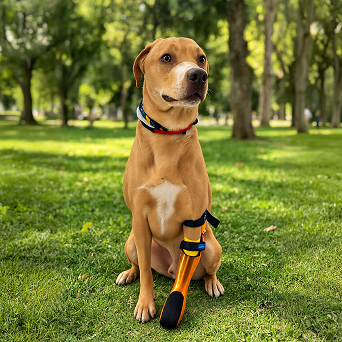
If you have made it this far, your dog is probably going through one of those moments no pet owner ever wants to face: an injury, an amputation, or a diagnosis that changes their quality of life. The first thing you want to know is what can help. And the first question that comes to mind for almost everyone is the same: does your dog need a splint or a prosthesis? The confusion is completely normal. Both are orthopedic devices for pets, both are custom-made, and both help your dog move better.
However, they work differently, are indicated for different conditions, and the fitting process is different. At C&D Bionics, we have made hundreds of devices for dogs in Colombia, Panama, and Costa Rica. In this article, we explain the differences clearly so that, when you speak with your veterinarian or contact us, you will know exactly what you are talking about.
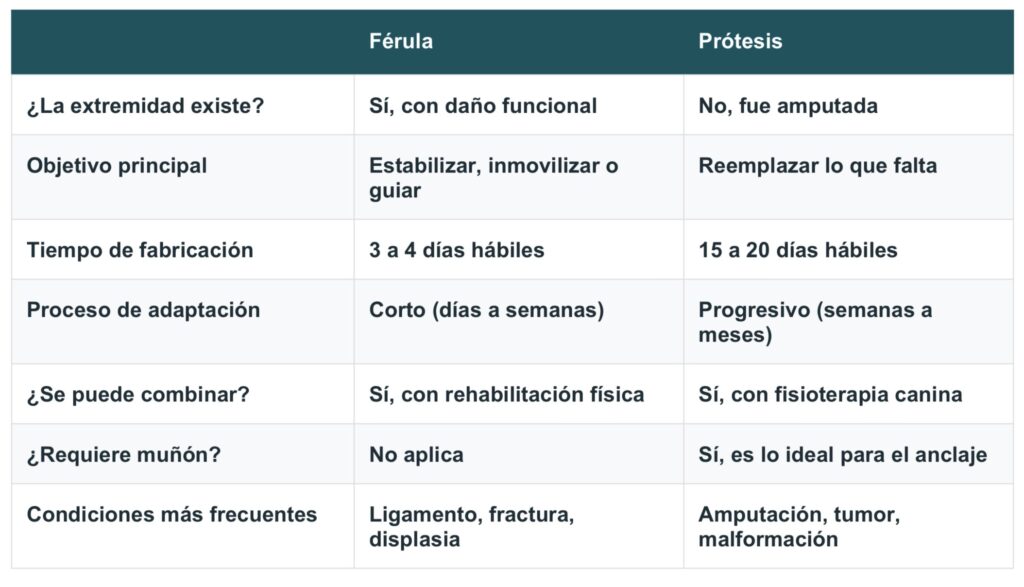
The difference between a splint and a prosthesis is not in the price—it is in your dog’s condition.
What is a splint for dogs?
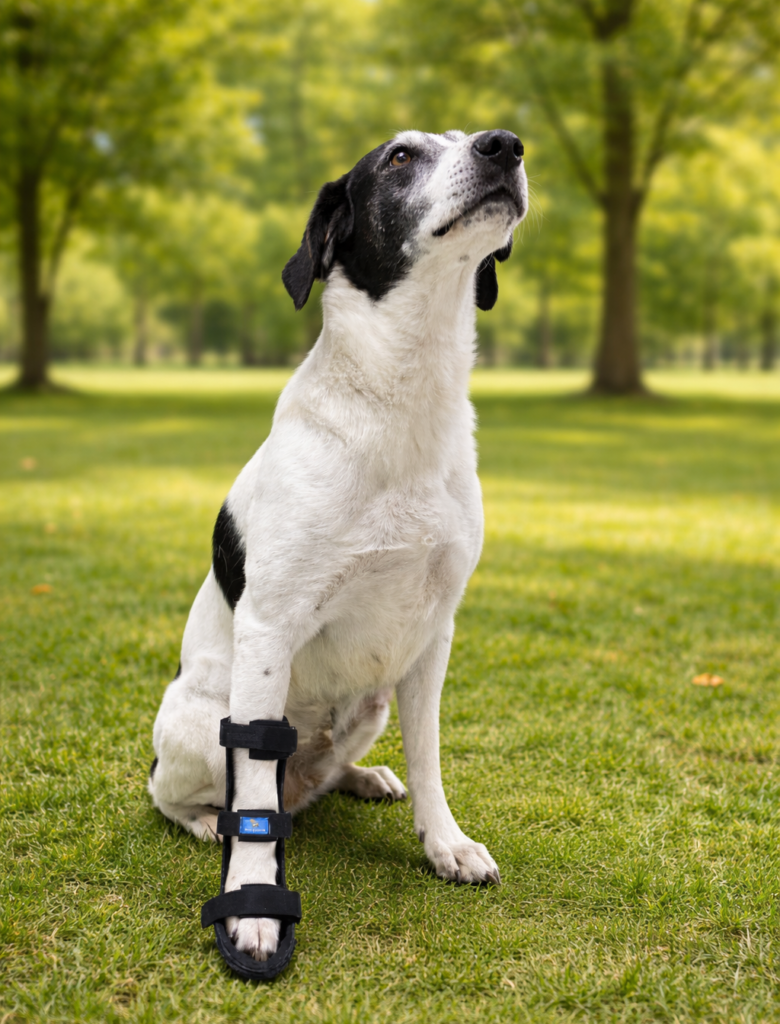
A splint is an external support device that is placed on a limb that still exists but needs stabilization, immobilization, or protection. Think of it as a partial exoskeleton that helps the leg do what it cannot do properly on its own.
Splints are used when the problem is functional: the leg is there, but something in its structure is not working properly. They can be rigid (to immobilize completely) or articulated (to guide movement in the right direction).
When is a canine splint indicated?
Your veterinarian may recommend a splint in the following cases:
- A fracture in recovery that requires immobilization without surgery
- Cranial cruciate ligament injury (the most common injury in active dogs)
- Elbow or hip dysplasia in functional stages
- Patellar luxation or joint instability
- Post-surgical recovery when the bone needs rest
- Muscle weakness that prevents proper weight-bearing on the leg
The key point is that in all these cases the leg exists and has functional potential. The splint is the support that allows the body to do its recovery work.
What is a prosthesis for dogs?
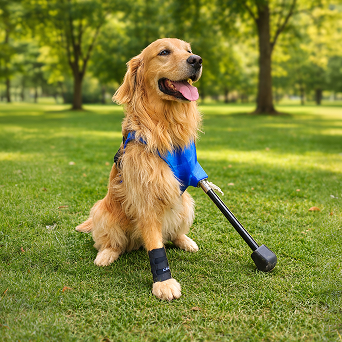
A prosthesis is a device that replaces a limb that no longer exists. It is used when your dog has had a total or partial amputation of a leg, whether due to an accident, a tumor, an irreversible injury, or a congenital malformation.
Unlike a splint, which works with what is there, a prosthesis builds what is missing. That is why the process is more complex: it requires very precise measurements, progressive adjustments, and an adaptation period in which your dog learns to use their new limb.
When is a prosthesis indicated?
- Total amputation of a front or hind limb
- Partial amputation that left a functional stump
- Congenital malformation that prevents normal development of the leg
- When the veterinarian determines that the limb has no possibility of functional recovery
A well-made prosthesis is not just a replacement—it is a second chance at full mobility.
Splint vs. prosthesis for my dog: the definitive comparison
What about a wheelchair for dogs? When does it come into the picture?
There is a third device worth mentioning here: the canine wheelchair. It is used mainly when the dog has paralysis or paresis of the hind legs (such as in cases of a herniated disc, degenerative myelopathy, or cauda equina syndrome) and is not a candidate for a splint or prosthesis because the problem is neurological, not structural.
At C&D Bionics, we manufacture all three options and can guide you on which one is appropriate based on your veterinarian’s diagnosis.
How do you know which one your dog needs?
The honest answer is that this decision is made by the veterinarian together with the orthopedic specialist. What you can do is come to that conversation informed.
As a general guide:
- If your dog has all four legs but one is not working well → ask about a splint or orthosis
- If your dog lost a leg or part of it → ask about a prosthesis
- If your dog cannot move their hind legs but still has them → ask about a wheelchair
- If you are not sure → contact us and we will guide you at no cost
The process at C&D Bionics: from measurement to device
Regardless of which device your dog needs, our process is the same: personalized, guided, and with real support.
- You contact us via WhatsApp or the form and describe your pet’s condition
- We schedule a video call to take the exact measurements using our guide
- We manufacture the device using 3D technology and lightweight, high-quality materials
- We ship it to any city in Colombia; we have also had success stories in Panama and Costa Rica
- We support you through the adaptation process with post-delivery follow-up
Every device that leaves C&D Bionics was designed for a specific dog. We do not make sizes—we make solutions.
Conclusion: there is no one-size-fits-all answer
The difference between a splint and a prosthesis is not about quality or price: it is about medical indication. The important thing is that, whatever your dog’s condition, real options exist today so they can move again with dignity and without pain.
If you have questions about which device your pet needs, please write to us. Our team reviews each case individually, and we will guide you at no cost.
Not sure what your dog needs? Tell us about your case and we will guide you for free